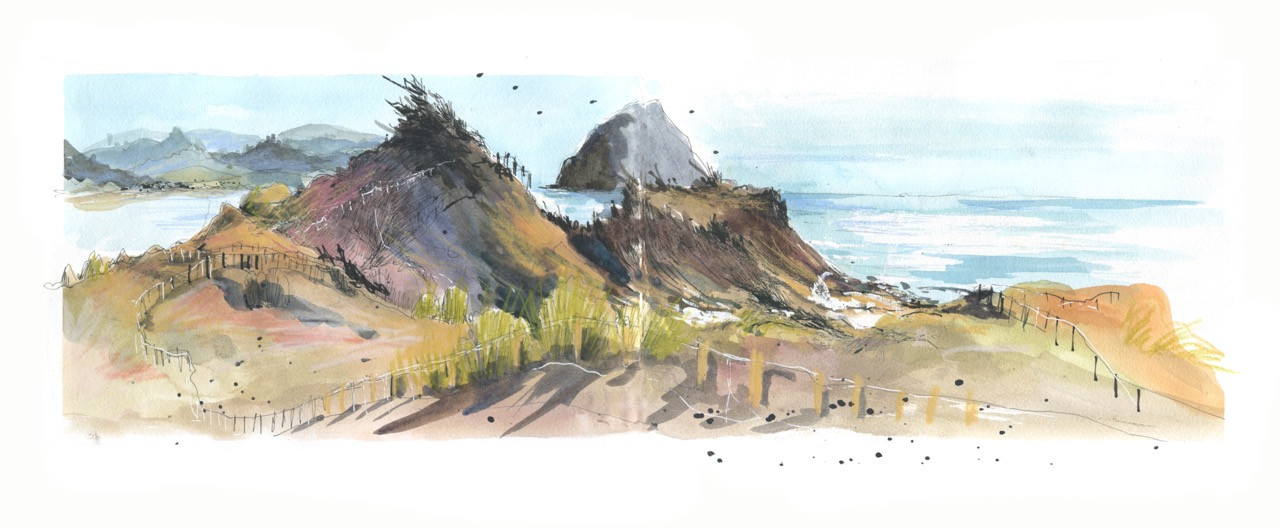
Description
Draw. Write. Tell the Story of a Place.
Travel reportage is a way to show the uniqueness of a place through quick sketching and storytelling. Instead of snapping photos, learn to observe deeply, and record your impressions in an expressive sketchbook.
Over the course of the workshop, you’ll create your own travel journal filled with lively drawings, written reflections, and atmospheric watercolor vignettes.
You’ll learn how to:
* Choose what to draw to best represent a place
* Simplify details (color, shape, perspective) to sketch on a budget of time and effort
* Combine drawing and writing for stronger storytelling
* Use watercolor to capture light, mood, and atmosphere
* Create playful vignettes that stand on their own
* Add depth using three simple visual tricks
Open to all levels. Use the skills from this workshop for exotic travel or document your everyday life, turning any place or experience into a visual story.
About the Instructor
She has taught Drawing, Urban Sketching and Visual Journalism courses at the Parsons School of Design, Pacific Northwest College of Art, and Portland State University as well as given numerous workshops and lectures on drawing and visual storytelling all around the world.
In the span of her decade-long career as an educator and visual storyteller Sabler has inspired diverse audiences to cultivate a lifelong passion for urban sketching and reportage illustration. Her work has been featured in solo and group local and international shows.
Rita Sabler’s reportage on the Kalaupapa settlement won Doctors without Borders Coup De Coeur and International Sketchbook Prize at the 2019 Rendez-Vous Du Carnet De Voyage in Clermont-Ferrand. Sabler’s book “Listening to New Orleans” won the International Sketchbook Prize in 2023.
Rita Sabler currently works as a freelance visual journalist for the Oregon Public Broadcasting. From 2019-2023 Rita Sabler served as the Education Director on the board of the global Urban Sketchers organization.
Rita’s main areas of expertise are Reportage Illustration, Travel Sketching, and Visual Journalism. She is often seen on street corners capturing busy markets, festivals, protestors, musicians, and regular citizens living their life in both ordinary and extraordinary ways. When not drawing or teaching she is a busy parent and a tango pianist.
Rita holds Masters of Arts degrees in Linguistics (UC Davis), Masters in Interface Design (The Elisava School of Design in Barcelona) and Master of Science in Journalism (University of Oregon).
Learn More
www.ritasabler.com
Materials List
You will need to bring:
Mechanical Pencil
Black ink pens with waterproof ink 0.2, 0.3 (Artist Pitt pen by Faber -Castell or similar)
Pentel Waterbrush, large Tip
Inexpensive sketch pad for quick studies and exercises (Clairefontaine Crok’ Book 8″ x 12″ Sketch Pad or similar)
Hot press watercolor paper, size 7”x9” or larger (either loose sheets or in a pad or block)
Old rag or paper towel
Watercolor paints in a palette
Instead of buying a box prefilled with colors that might not be that useful, I recommend getting a small Portable watercolor box with lots of surface for mixing, half pans, and tubes of watercolor paints that you would squeeze into the pans. I recommend the following brands of watercolor paints: Daniel Smith, Sennelier, QOR, Schmincke, or Windsor and Newton.
Indian Yellow or Hansa Yellow or Lemon Yellow
Scarlet Red
Ultramarine Blue
Brown Green by Sennelier
Burnt Sienna or Transparent Red Oxide
Sap green
Payne’s grey or Indigo
Phthalo Blue or Prussian Blue or Windsor Blue
Magenta or Rose
Provided by instructors:
Some tubes of watercolor paint to share, extra brushes and watercolor paper